Sunday, April 29, 2018

Taking On The SBAC for Secondary ELA All Year Long (Without Going Crazy)


It is the inevitable fact of life that for at least for most teachers in the U.S., state testing becomes a glaring part of our realities in the spring. I'm not a huge fan of having to administer the state test, and I suspect your students aren't either. I understand why the state testing helps keeps schools accountable, but the nature of the test just gives everyone involved such stress and anxiety, especially in the last few weeks and days leading up to it. But I digress! This post is about how I prepare my secondary ELA students for the state testing in the spring, all year long so that we all don't go crazy.

Just some background info before I get into this post: I'm an 8th grade ELA teacher in Southern California, which means my students take the SBAC (Smarter Balanced Assessment Consortium Test). For secondary students, the test is broken up into two pieces: 1) The Performance Task, and 2) The CAT (Computer Adaptive Test). The Performance Task usually involves students analyzing about 4 sources and answering 3 short answer response questions + writing 1 essay, and the CAT test is usually about 40+ mixed types of questions (short response, multiple choice, highlighting answers, etc.). The entire test is taken online, which can sometimes lead to drama that I'll detail later in this post.

Before the school year began
I don't like the idea of "teaching to the test," but I do think it's important to teach the same concepts of the test to my students throughout the year. In the summer, I sat down and looked at practice tests and wrote down all the concepts that came up in the questions many times. I used https://practice.smarterbalanced.org/ many times to see the sample questions for my grade level. I also took some time to look at other grade level questions to see how other grades are being assessed.

In California, the website for administering the SBAC is http://www.caaspp.org/. On the website, teachers can also view and administer the IABs (Interim Assessment Blocks) or ICAs (Interim Comprehensive Assessments). These are benchmark assessments you give your students throughout the school year to prepare them for the state test. I also viewed these tests to see the concepts that came up many times.

In my yearlong planning, I made sure that the units that I taught spiralled in these concepts many times, especially inferences, context clues, main ideas vs. claims, etc. I also made sure that I planned to teach the three main types of writing throughout the school year before the state test: narrative, explanatory, and argumentative.

Throughout the school year
During the school year, I taught the concepts that I narrowed down in the summer and made those some of the important words part of my word wall. I have my students record these words into a study list on Quizlet.com, and at the end of every unit, students are tested on these words.

I also gave an IAB at the end of every unit as well. The nice thing about the IABs is that you get scores really quickly, sometimes with a 1 day turnaround. For some ELA IABs, however, you have to hand-score some answers. So if you have 100+ students, this could take a lot of extra time that you might not have. For me, it was worth it to do a few IABs with hand-scoring items so I could see how my students were writing their constructed response answers. It really helped students to learn the strategy of RACE (Restate, Answer, Cite, Explain.) Having a format for "text-box" questions (that's what I started to call them) helped students really get over the anxiety of "I don't know what to write" syndrome!


Reading and scanning passages, and answering text-dependent questions were skills we also focused on every week. Every week I had my students read a NewsELA article online and take the quiz that comes with it for a few reasons: 1) It helps get them familiar with more informational texts, 2) the news is all current 3) I allow them to choose which articles they want to read, which keeps them more engaged. If they pass the quiz with a 4 out of 4, I also reward them points for the reading program in my classroom (a blog post will come about this later!)

One month before the test
I gave four IABs over the course of the school year:
  • Reading Literary Texts
  • Reading Informational Texts
  • Research
  • Edit/Revise (Grammar)
After reviewing my students' scores on these IABs, I collected the names of students who scored below standard. I created "ELA Boot Camps," which were special tutoring sessions after school. Every week in April, I focused on one of the IABs for my ELA Boot Camps. The students who scored below standard only attended the ELA Boot Camp that they scored below standard on. During the boot camp we viewed that particular IAB together and went over the questions as a group. I modeled for my students how I would narrow down the answers. Mostly we went over the strategy of READING THE QUESTION FIRST before reading any passages. I told them that for most of the questions, reading the passage in full isn't really necessary. You can just scan the passage for the key words from the question and be able to answer using prior knowledge and good 'ol common sense!


Two weeks before the test
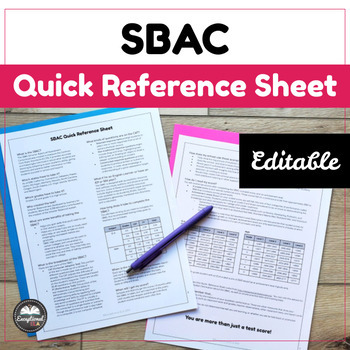
We started explicitly reviewing for the test at this point. I explained to the students what the SBAC test is and why we are taking it using the SBAC Quick Reference Sheet I created:


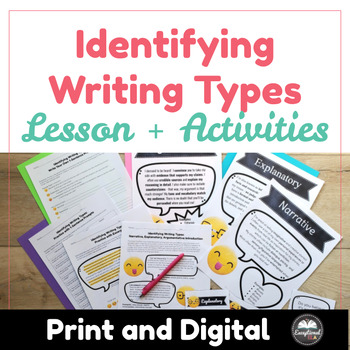
The next day, we reviewed the three types of writing using the activity I created Identifying Writing Types. It really helps them to remember what we've written over the past school year and hammer in how those writing prompts might come up on the test.


Next, we practiced with the Brief Writes IAB, which includes short response questions. We did this as a class, instead of me assessing them on this skill individually. Most of questions go like this: "Read this essay from a student and write an introduction or a conclusion to go with it." We practiced with three Brief Writes (one narrative, one explanatory, and one argumentative). We did the narrative one together, I scaffolded and modeled how to complete the explanatory one, and I assigned the argumentative Brief Write as homework. This took about 2 lessons to complete.

Next, we practiced with the online CAT (computer adaptive test) in conjunction with filling out the SBAC Heavy Hitters Study Sheet that I created. This sheet really helped students understand the main concepts of the SBAC test. We did this for about 3 lesssons.
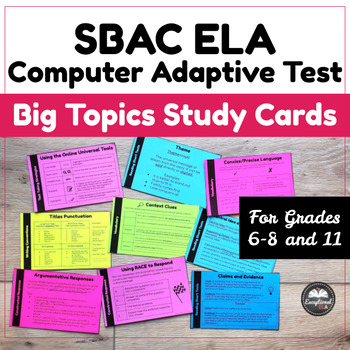


We played trashketball along with the practice CAT too! I had students answer in small groups of 3-4. If their group got the answer correctly, they got a chance to shoot a paper ball into a trashcan and earned points. I created a 1-point line and a 3-point line farther away. Whichever group got the most points got class coupons!


Next, we turned our attention to the Performance Task. I used the Performance Task Cheat Sheet I created to help students understand where to look first when they log on to the test. It's a beast, really, so much information to look at, and it can be hard for students to focus on the important parts if they don't know what they are!
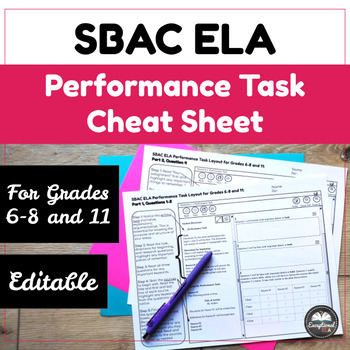


Then, we practiced with an actual performance task. We used the Performance Task IAB together and analyzed the sources in groups to find the main claims, and we talked about how to use RACE for the short answer questions in Part 1. For Part 2, we created outlines for the essay, but didn't write out the whole thing (there would be time enough for that on the real test). We reviewed what basic 5 paragraph essays look like and how to "sandwich" evidence + explanations in between topic and closing sentences. We reviewed what introductory hooks look like and how to write thesis statements. It's not the most exciting material ever, but having some direct experience with this helps gives students confidence for when they're facing it on the SBAC by themselves.

Creating motivation and encouragement
A week before the test, I blasted out an email to all my students' parents about candy donations to create "testing survival kits."


I got the idea from perusing Pinterest, of course! I also had my students write positive encouraging notes on a slip of paper to a random student, and we put those in the testing survival kits along with the candy and stickers. A student and I assembled 100 of these bad boys after school one day. You can get the editable labels here:
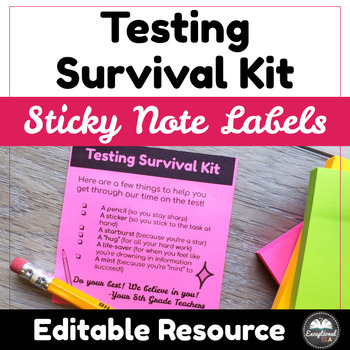


When we passed them out on the first day of testing, the students mood shifted from stressed/frustrated to all smiles! Sometimes a little bit of free food goes a long way!

The day before the test
We took a break from test review. I had students color in little donuts and write positive messages on them to add to our "Donut Stress About the Test!" poster. I told the students that getting a good night's rest and taking time to relax would help them prepare for the test. I also said that if they wanted to review last minute items, the Heavy Hitters Study Sheet should be the only thing they look at! I emphasized to them that this test is only one indication of their academic performance, and definitely doesn't represent their worth as a student or as a person!


During testing
I asked my principal ahead of time if we could allow students to eat snacks during testing and he gave the okay. Honestly, allowing students to eat and have snacks during the test has made a big difference in their comfort and stress levels. It's something special they get to do during the test that they don't normally get to do!

Also, every year without fail, there will be tech issues. On the second day of testing this year, we dealt with our students being unable to log in from 9:30am until the end of the school day. It was an exercise in frustration, and all I could do was tell my kids that they had to patient. I told them technology is an amazing tool, but we have to flexible and realize it doesn't always work perfectly all the time. We ended up playing board games for the rest of the day in my periods where the login wasn't working. It worked fine for the rest of the test!

Anticipate some students not taking the test as seriously as other students. Some will finish much faster than others. There is nothing you can really do beyond telling them to try their best. Know that you've done everything you could to encourage them, but in the end, the students make their own decisions about how they perform on the state test, even if they're perfectly capable of scoring proficiently. It is what it is.

On the flip side, have a plan for what to do with students who take much longer than others to complete the test. At our school, we send late finishers to the teachers who have prep periods during that time so I can begin teaching lessons again. For example, if I have a few late finishers in my first period class, I will send them to the teacher who has 1st period as prep time. Of course, this was worked out already with the 1st period prep period teacher. I work at a small charter school so we all know we need to support each other in testing. But in lieu of this, we've also had a separate room set aside for testing and had a teacher sit in every period to get students done with the test. With the SBAC, students should get as much time as they need to complete it.

After testing
It took us about 6 school days for every student to complete the 8th grade ELA test in it's entirety (regular 55 minute class periods - no special block scheduling). I was SO DONE with testing, and students were SO DONE with testing. On the last day, I decide we should throw paper balls at each other. It was the best. Thing. Ever.


That's about it!
The rest of the school year my students and I are taking on our career research projects which will result in a mock career fair! A later blog post and TpT resource will be coming about this soon!

Let me know if you have any questions about administering and/or preparing for the SBAC test with your students and I'll definitely make sure to get back to you as soon as I can!

-Stacey


Follow

Sunday, April 8, 2018

That Time I Presented At A Teaching Conference


I don't know what it is about speaking in front of other teachers, but when I have to do it for professional development from time to time, I often get really stressed out and worry about it the entire time until it's over. Other teachers share the same sentiment! Odd being that we speak in front of our students every day and don't really think twice about it, but when it comes to adults... forget about it. This is definitely how our students feel when they have to present in front of the class.

How I applied to be a conference presenter

So naturally, when I had the opportunity to become a conference presenter, I jumped at the chance!! Haha... not really. But the opportunity did present itself without me really looking for it...

Last year I was teaching a lesson with the principal present in the classroom, as one of my official teacher observations. I decided to ask him to come to one of my hybrid Socratic seminars, which is like a regular Socratic seminar, but with a technology twist! I ended up making my first TPT resource based on this: check it out!


After the evaluation, I was nervous to get my observation notes back. To my surprise, they were really good! My principal even told me I should consider submitting this activity as a presentation at an upcoming charter school conference that he presented at some years ago. "It was a great experience for me!" he wrote in his notes. I thought about doing this in front of so many people, and my stress levels rose through the roof. I thanked him for his notes and said I would think about. 

That was in May of 2017 and I forgot about it until the school year started up again in August, when my principal sent an email around to select teachers who had unique activities/lessons going on in their classrooms and said that the deadline for the charter school conference was in November, if we were interested in applying. The school would pay for our hotel room, transportation, and meals if we were selected as a presenter. That was intriguing... I had never presented at a conference before... and this would be a great challenge for me, and one I could take back and talk about to my students when it was over... I talked to my husband about it and he seemed keen to it, and said that he would support me if I wanted to it. So besides all those negative thoughts in my head telling me I wasn't good enough for something like this, I decided to go for it. I came up with a catchy presentation title: Hack into Hybrid: The 21st Century Socratic Seminar (gotta love that alliteration), and I wrote a 30-word description of my lesson in my application (which took 2 days to write in the most specific and succinct way I could). Finally, I hit submit and decided to leave in in God's hands. 

Reaction to being chosen

November soon rolled around. Out of the 5 teachers that the email was sent to, 2 of us decided to apply, and out of the 2 of us, I was the only one chosen! I was extremely surprised that I was the only one chosen to represent our charter school and my immediate thoughts were dread and stress, but also so excited that I was given the opportunity to present in front of other charter school stakeholders. I was relieved that the conference was in March 2018. I felt like I had enough time to prepare an HOUR LONG (!!!) presentation until then. I found out that I would be presenting on the third and last day of the conference and at 8:30 am. Well, I thought... At least not that many people would show up that early?? (Later, I would turn out to be mostly wrong. Teachers are used to getting up early!)

Preparation

The preparations began. I created a Google slideshow all about Hybrid Socratic Seminar and I really had to break it down in several components so that teachers could understand my process fully and take this back to their own classrooms. I then had to make sure I was teaching Hybrid Socratic Seminar sometime between November and March, so I could videotape my students actually participating in one (I prayed that they could produce good discussions that were appropriate and thoughtful, haha. Luckily, they did!) 

The director of my charter school offered to watch me present my slideshow so that he could give me feedback, if I wanted, before doing the real deal. I accepted his offer, despite me being nervous presenting in front of him as well. I wanted to make our school proud and offer teachers something tangible and useful to bring back to their classrooms and I wanted it to come out in a coherent way; I just hoped that if I could do it in front of him, I could do it in from of strangers in March.

It was February 2018 when I felt that I had a good presentation with video to show my director. He ended up bringing one of the board members to my presentation as well, so that made me more nervous, but also happy because they both were taking time out to help me do this (mixed emotions were rampant in this time of my life). It turned out better than I thought and they gave me lots of good advice and feedback that I never even thought of - such as explaining to teachers right at the beginning why Hybrid Socratic Seminar is worth doing FIRST, before jumping into the process, and adding some research driven data to really hone in the importance (admin and data go together like peanut butter and jelly). They also suggested I videotape the students' reactions to Hybrid Socratic Seminar, as in what they thought about it, how it's useful to them to speak their minds and opinions, etc. Luckily I had just taught my students how to use Flipgrid so this was a piece of cake! I was grateful for all of their advice - I don't think the presentation would have turned out so thorough without them. 

Arriving at the conference

My official badge!
It was finally the end of March and I arrived with my family at the conference. I brought my slideshow and videos on my laptop AND on a flash drive. I brought speakers in case the room where I was presenting didn't have any (which of course they did). I brought 50 copies of my handouts. I triple checked all my slides and made sure I had my laptop charger. I was really paranoid that all the audio-visual stuff wasn't going to work. Technology can be so finicky when you actually WANT it to work. 

I went through the first two days of the conference happily, yet I knew that my presentation was coming soon, so I tried to shove those feelings of nervousness way down deep inside until the third day rolled around. One thing I definitely felt while I was there - I really felt like a small fry, compared to all the administrators and directors and other head honchos who were present there! Honestly, I looked at the presentation list, and I was just one of a handful of classroom teachers that were presenting. I had a long talk with my husband on Tuesday night about my nerves, and he did his best to reassure me that they wouldn't have picked my presentation if they didn't find it valuable. My principal and one of my colleagues went to the conference too, and they reassured me of the same thing. They want to see what's actually happening in charter school classrooms - and my presentation would be an excellent example of that! Still, Tuesday night, I was mostly a wreck, going over my slides over and over again as my toddler went nuts in the hotel room (luckily he fell asleep without issue and I got a few hours of sleep in too!)

The morning of my presentation

The sign right outside of my presentation room!

I left the hotel early without my principal and my colleague to set up. I got to my room around 7:30, an hour before I was supposed to present. No one was there in my room yet, but there were definitely people in the convention center who were walking to various rooms. Thankfully, I figured out how to plug in my laptop and work the speakers and the microphone all on my own. That was such a relief to me, because that was a huge source of my stress! After about 15 minutes, I was already set to go, but I still had to wait 45 minutes!

I met my moderator not that long after, who was a young guy who worked for the organization that set up the charter school conference. He had a very soothing voice and he told me that he was excited for my presentation. He had seen it in the catalog and was intrigued by the integration of technology into classroom discussion. I found out that he grew up in the same city as I did! This conversation actually helped me relax a lot, and I was grateful that he was chosen to be my moderator. Not long after I spoke to him, my colleagues came in to support me, and other audience members trickled in. My principal told me that at the end of my presentation he had counted 26 people, which is pretty good for a large conference with so many presentations to choose from in the same time slot!

Actually presenting
Looking like I know what I'm doing!

I definitely was nervous once my moderator introduced me and I began. It was a slow beginning, as I had a link for everyone to go to on their devices to see my slides, and I had to wait for everyone to be on the same page. But soon after that, I was doing it! I was presenting! And I finally started to relax and feel comfortable about what I was doing! It's exactly as I always tell my students when they get nervous about presenting - just jump in and do it and you'll do fine! 

At the end of my lecture we had about 10 minutes left. I was shocked that I was able to make my presentation stretch as long as I did! I left it open to audience Q&A, and I was very pleased to hear the kinds of questions being asked, such as "How do you get your students to feel comfortable discussing controversial topics?" and "How do you 'let go' in the classroom and allow your students to take over the discussion?" and "How do you teach students to listen as well as they participate?" I don't know how I came up with the answers I did but my principal later told me that I answered the questions better than he would have. Some of the people in the audience started to feed off each other's responses as well, in a positive way! This was so much better than I thought it would be!

After presenting

So relieved after I was finished. Two of the teachers in the audience approached me after the presentation to tell me that I did a great job and that they were inspired by my students and I, and they would try Hybrid Socratic Seminar when they got back to their schools. They even emailed me later that day to get the resource digitally! 

I was so proud of myself that I was able to take on this public speaking challenge. Right after my presentation, and after high-fiving my colleagues, I felt a huge weight lift off my shoulders. I went directly back to my hotel to collapse in a heap.

Given the opportunity to do this again, I most definitely would.

Some conference tips, for anyone that will be presenting for the first time!
  • Arrive early to set up. At least 30-40 minutes early. You might not know how the room is laid out ahead of time, or what technology you will be provided with... And, it's also good just to have some time for mental preparation.
  • Come prepared for any technical glitch. As I mentioned earlier, I had my slideshow online, on my desktop, and on a zip drive. I brought speakers, hard copies, and my laptop and phone charger. You just never know!
  • Have a way for audience members to engage. From watching other presenters at this conference, this really is key for understanding and for the audience to remember you. I had Q&A at the end of mine, but other presenters had mini-lessons for everyone to participate in, or had live surveys for everyone to take during the conference, or simply used their winning sense of humor to get everyone to laugh (wish I had this talent!).
  • Show students in action in your presentation. The point of any teaching conference really is to get our students to succeed. So when you have pictures or videos of your students in action, everyone is reminded of their purpose for being there, and it makes your presentation that much more relevant to teachers. 
  • Get feedback from an outside party. I was able to present in front of my director and came away with a lot of good ideas, but try presenting in front of another teacher friend, or even a non-teacher friend and try to get their perspective on it. Did they understand every aspect of your presentation or were some parts unclear or confusing? I promise this is worth your time to make your presentation so much more effective! 
  • Show data that proves the effectiveness of your presentation. I used data from John Hattie's book Visible Learning and how classroom discussion has a bigger effect size than direct instruction. Real numbers can sometimes drive the point home stronger than anything else. 
  • Provide teachers with a tangible lesson to return with! Always give both hard copies and digital copies of your slideshow. Think about being a teacher at a large teaching conference and being able to choose the presentations you want to attend, and therefore foregoing other presentations you won't be able to attend as a result. You want to make sure the presentation you chose had some real takeaways that you can use in your classroom right away! As a presenter, keep this in mind when developing your presentation. I used goo.gl to create a shortened URL for my slides so it was faster and easier for teachers to access, but I saw other presenters using Nearpod. I also included a slide at the end of my presentation that had my email address and instagram account so that teachers could reach me after my presentation if they wanted!
  • Have a support system in place. Having my husband and son at the conference was invaluable to my mental health while I was there! Having my principal and my colleagues watching my presentation was also a big boost. I definitely would not have felt comfortable doing this for the first time without them!
...And that's it! My almost yearlong journey to presenting at my first big conference. Let me know if you have any questions about what I did, and I'll do my best to answer! Share out below if you've ever presented at a big teaching conference, and what it was like for you the first time! 

Thanks for reading,
Stacey

P.S. Here are my slides from the conference, if you'd like to see them!

Hack into Hybrid: The 21st Century Socratic Seminar


Follow

Saturday, March 24, 2018

One month update as a Teacherpreneur!

I've been creating resources for Teachers Pay Teachers and trying to build up my "brand" for about a month now, and feeling somewhat bummed that I've put in a lot of work and none of my products have really took off yet. I wanted to make a list of the things I've accomplished in the past month: partly to prove to myself that I have been working hard (even though it doesn't feel like it) and that the rewards of my labor are simply more than the dollars I've earned! And also: bullet point lists. Is there nothing else more soothing to the crowded mind of a teacher/mom/wife?

What I've done:

  • Read and researched a TON of beginning TpT resources from other teacher authors
  • Created a name, Exceptional ELA
  • Created a logo
  • Created a store quote and a store banner
  • Learned how to use clipart from other artists responsibly
  • Created 7 resources (2 free, 5 paid)
  • Kept to my goal of uploading one resource per week and then some!
  • Started the Exceptional ELA Instagram account, now with 169 followers and counting!
  • Started the Exceptional ELA Pinterest account
  • Started this blog

What I've gained:

  • Some graphic design skills! I never knew how versatile Google slides can really be! It really is a workhorse! 
  • Learned how to use new websites and apps, especially Canva! I'm definitely going to use this in the classroom a lot more for my students.
  • Social media marketing skills: It's a whole new beast to tame, that's for sure...
  • New resources I was going to make for my classroom anyway, but now I can share with other teachers who could also use them.
  • Tons of connections to other teachers online who are in the same boat as me
  • A newfound passion for making my lessons, activities, and strategies more engaging and rigorous than ever before!


"Yay!" moments:

  • Sold my "Literary Limericks" resource twice!
  • One teacher on Instagram tagged me in a post, saying that I was one of the inspirational teachers she followed last week!


All in all, really awesome for a month's work. I've been working mostly at night when the toddler has gone to bed and the chores are done. I've gotten a little less sleep, but I feel an even greater appreciation for the profession I've chosen. I'm looking forward to see where Exceptional ELA will take me a little further down the line.

For now, I feel content with the pace in which I'm going. I'm enjoying my spring break, and gearing up for a presentation I have at CCSA (California Charter School Association) Convention next Wednesday. Hoping all goes well! I'm nervous about it, but I have to remember to still enjoy the time I have off. Spring break always goes entirely too fast...

Follow

Monday, March 19, 2018

Am I good enough? (A post told in Leslie Knope Gifs)


I'm pretty sure this is a question our students have asked us from time to time. Maybe not in those exact words, but questions similar to it. Everyone wants validation that they're doing the right thing, or that someone is appreciating the hard work they're putting into it.


Every time a student asks me a question like this, I never hesitate to say, "Of course, you're doing amazing things!" or "Keep at it: I'm so glad you're giving it your best shot!" Growth mindset over fixed!


But when it comes to me? Asking myself the same question? Especially when beginning as a new Teacher-Author on TpT, I am constantly asking myself...

Am I good enough? Is my work as a teacher good enough? Can I make great resources? There are so many others before me who have done much more and are so much more creative and hard-working than I am. Who would really want to use my stuff when there is so much more to choose from? What even is the point? Should I even try?


Am I good enough? My students are learning in my class! My students feel safe in my class. My students love coming to ELA. This is what they tell me. But still, am I really good enough to be more than "just" a classroom teacher? Are my ideas unique enough? Are they engaging enough? Do they utilize the newest resources enough? Do they hit all the right standards? Will they remember this tomorrow, a week later, a year later? Does it matter if they do? Is someone else doing this in a better way? Am I I just fooling myself by thinking I can do this too?


Am I good enough? I don't just have 100+ students to teach, I have a family to take care, too! Am I spending enough time with my young son? Am I dedicating enough time to my marriage? Am I spreading myself out too thin? Should I even be trying to attempt this right now when I already have so many responsibilities? How do those other teacher moms do it all? Could I ever be like them?


Am I good enough? Who am I asking really? What do I want to hear? Shouldn't I just try and not worry about whether or not I'm good enough? Don't I enjoy challenging myself? Don't I like sharing what works? Don't I like making connections with others?


But I remember what I tell students when they ask me if they're good enough. Yes, I am good enough. I am just starting but I can do this. I don't have a lot of extra time but I don't have to do everything all at once. I can build this slowly. I am lucky and blessed that my family supports me in trying new things.


Even I reach just one person, and even if that one person is myself, I am good enough. I can do this and I have something new to offer.

I might not be extremely successful at it, but I will give it my best shot. I will give myself the best chance by believing that I am good enough.


Follow

Friday, March 16, 2018

Welcome to Exceptional ELA!

Hi everyone!

I am so happy you found your way to my little corner of the internet! Before I dive into the blogosphere, I wanted to introduce myself briefly.

Here's a little about me:

I'm a wife to another teacher, and a mom to a rambunctious toddler. Balancing work and family life is never easy, but I love it, and I'm grateful for my loving and supportive husband who guides me through it all.

I live in Southern California, where the weather has made me weak! I love the rare rainy day we get here, but I also love the sunshine. 90 degree Christmases are the norm here...

I love reading and writing creative short stories and drinking copious amounts of coffee. I've traveled a lot in the past, and when my son gets older, I'd love to do more of it. I love sleeping in until 7am, when I can. The teaching and mommy life doesn't really allow for this though. I love shopping on Amazon (maybe too much). I love finding quirky pieces of clothing to wear to school, but I also love being comfortable (leggings for life!)

Teaching experience:

I went to UCLA for my BA in English, and Claremont Graduate School for my MA in Education. I am currently an 8th grade ELA Teacher and have been teaching secondary ELA since 2012. I have taught both middle and high school grades. Before settling into public school, I taught ESL in America and Japan.

Teaching style:

I love creating lessons and activities that engage and challenge students! In my project-based classroom, you'll see a lot of movement and student collaboration. Student voice is essential: they write their hearts out and learn how to share their opinions respectfully while learning about others' perspectives.

In addition, I integrate technology in novel ways. With the right guidance, 1-to-1 technology can transform a classroom to meet the needs of the 21st century. Flipgrid and Newsela are some of our most used apps in the classroom.

I also emphasize organizational and study skills. One of the cornerstones of my classroom routines and procedures is that students all keep an updated ELA binder so they can easily access their work in one place. These skills become more valuable in the future when keeping up with the rigors of high school, college, and their future careers.

Lastly, my students read voraciously. Our classroom library is forever growing! I constantly do my best to add the latest relevant and diverse texts and titles so my students can keep up with the world around them and find something that is sure to meet their interests!

What I hope to accomplish with this blog!

I'd like to do a number of different things on this blog: ELA related and general teaching related!

1. Share my experiences as a beginning Teacher-Author on TeachersPayTeachers
2. Share the lessons and activities I teach in my largely projects-based classroom
3. Review different edtech tools that would be suitable in the 1-to-1 technology classroom
4. Review new up-and-coming YA novels
5. Share my classroom management strategies
6. Share any budget saving strategies for the classroom I've learned over the years
7. Get ideas from other awesome secondary teachers!

That's it for now! Please comment below if you have any questions, and I look forward to sharing my thoughts with you as an educator here!

❤️Stacey

Follow